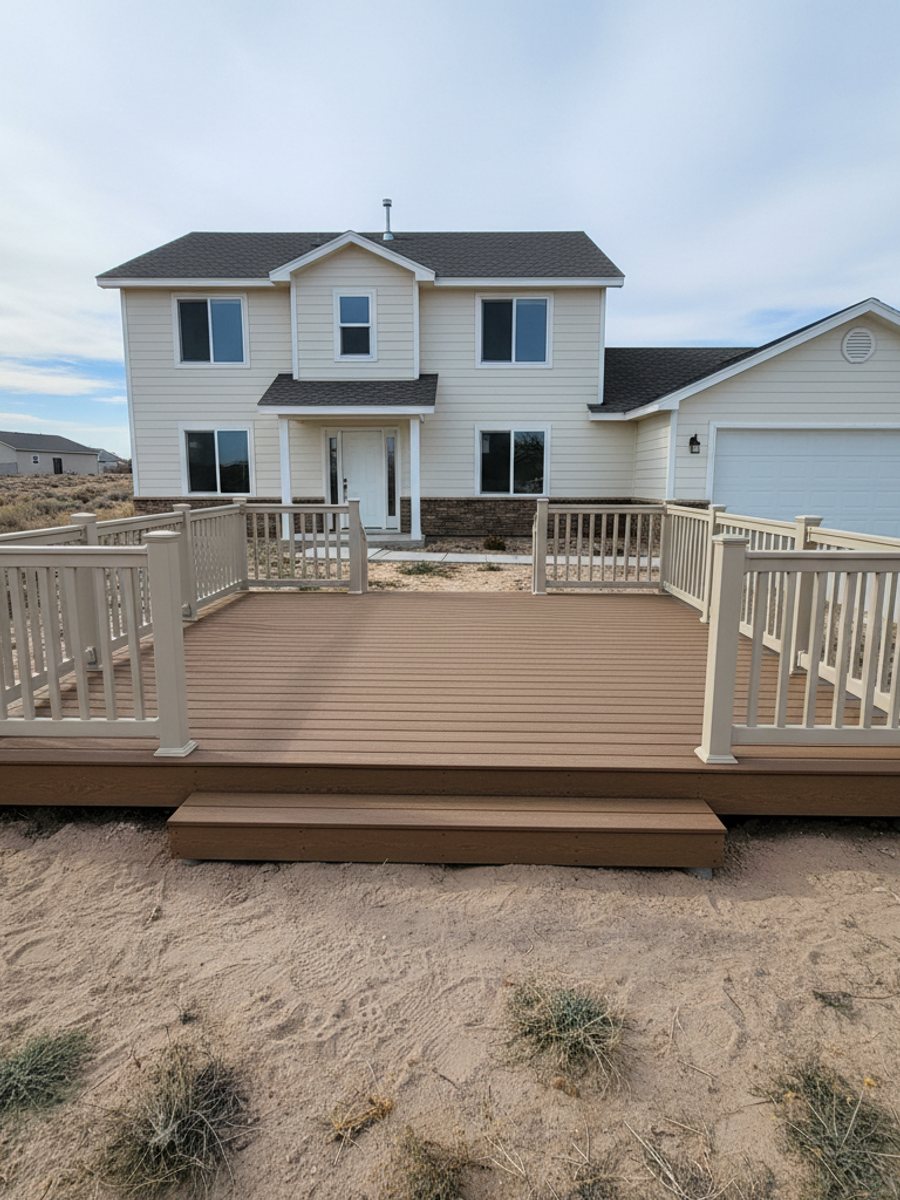
Most homeowners think about deck timing the way they think about painting a fence: pick a nice day and go. In Las Vegas the ground and the sky have more say in it than that. The soil here fights you differently depending on the month, concrete cures wrong if you pour it at the wrong time of day, and the wood you build with reacts to 110-degree sun in ways it never would somewhere with real humidity. Getting the season right isn't about comfort for the crew, though that matters too. It changes how long the deck actually lasts.
The caliche problem doesn't go away, but the ground does
Under a lot of Las Vegas valley lots, a few feet down, you hit caliche, a cemented layer of calcium carbonate and clay that can be harder than the concrete you're about to pour into it. Digging footings through caliche is slow work any time of year. But in July and August the topsoil above it bakes rock-hard too, and the crew is fighting two hard layers instead of one, in heat that makes an eight-hour day feel like twelve. In late fall through early spring, after a little rain has softened the top few inches, the digging goes faster and the crew isn't working through the hottest part of the day just to survive it. That alone can shave a day or two off a footing install.
Concrete doesn't care that you're in a hurry
Footings and post bases need concrete that cures properly, and Las Vegas summer heat works against that. Above roughly 90°F, concrete can flash set, meaning the surface hardens before the batch has had a real chance to gain strength underneath. That leaves you with footings that look fine and aren't as strong as they should be. Crews pouring in June through September have to water-cure aggressively, sometimes covering fresh concrete and misting it through the day, which adds labor and adds risk if anyone skips a step. Pour that same footing in November and it cures at the pace concrete actually wants, with none of the babysitting.
The real window: October through April
For actual construction, the stretch from October through April is where most of the good work in this valley gets done. Daytime highs sit in the 60s and 70s for a lot of that window, which is comfortable for the crew and kind to the materials. There's also less chance of monsoon disruption. July through September brings sudden, hard downpours to the valley, sometimes close to an inch of rain in under an hour, and a job site with open footings or a half-framed structure doesn't handle that well. A framed deck with no roof over it can take on standing water fast if a storm rolls through overnight. Scheduling around monsoon season isn't caution for its own sake, it's just what the forecast does here for three months a year.
Winter here is mild by most standards, but it isn't nothing. Overnight lows can dip into the high 30s in December and January, occasionally lower out toward Pahrump or up around Mount Charleston. That's not a freeze-thaw problem like it would be somewhere with real winters, but it's cold enough to slow concrete cure time and to make staining a bad idea until the afternoon warms things up.
Wood and composite behave differently once the heat hits
Wood decking installed in May and left to sit through a Las Vegas summer dries out and checks faster than the same wood installed in October, simply because it's fighting sun and low humidity from day one instead of getting a few cooler months to settle in first. Composite doesn't crack the same way, but it gets hot enough in July to be genuinely uncomfortable barefoot, sometimes past 140°F on darker boards in direct sun. That's not a defect, it's just what a dark polymer surface does at 110 ambient with no shade. A homeowner who wants composite and plans to actually use the deck through summer should think about lighter board colors and any shade structure, a pergola or a cover, before the composite goes down, not after.
Staining and sealing run on their own clock
Staining and sealing don't follow the same calendar as framing. Most sealants and stains want surface and air temps in the 50 to 90°F range to cure right, and they don't want direct sun baking them while they're still wet. That rules out midday from June through September almost entirely. Spring and fall mornings are close to ideal. Because the UV here is intense almost year-round, a sealed deck in Las Vegas wants recoating more often than the same deck in a milder, cloudier climate, closer to once a year than the two-to-three-year interval you'd hear quoted elsewhere.
Permits, HOAs, and getting the paperwork moving early
The permitting authority depends on the address. City of Las Vegas, Henderson, North Las Vegas, and unincorporated Clark County each handle deck permits through their own building department, and each usually wants a plan review plus a footing inspection before anything gets covered up, followed by a final inspection. A large share of the valley sits inside a planned community, from Summerlin to Anthem to Green Valley, and the HOA there will likely run its own approval on top of the county's, covering things like railing style or setback from a property line. That review can take a couple of weeks by itself. Starting that paperwork in late summer, while it sits in review, lines up well with a fall build start, which is the window you want anyway.
Older neighborhoods, newer ground
A deck project on an older street, say around the Scotch 80s or John S. Park, often means working around mature landscaping, established irrigation lines, and a slab or footing layout nobody has records for anymore. A deck going into a 2005-built subdivision out toward Summerlin or the southwest valley usually has cleaner soil and grading records, but newer fill dirt can still settle differently than the compacted, sun-baked ground on an older lot. Either way, a site visit before anything gets scheduled tells you more than a satellite photo ever will.
None of this means a deck can't go in during July. Sometimes a homeowner has to get it done and that's the job. It just means the finished deck, and the schedule behind it, both do better with a fall or spring start. Omega Deck Inc plans most builds and full resurfacing jobs around that window, and pushes staining and sealing work into the mornings even outside of it.