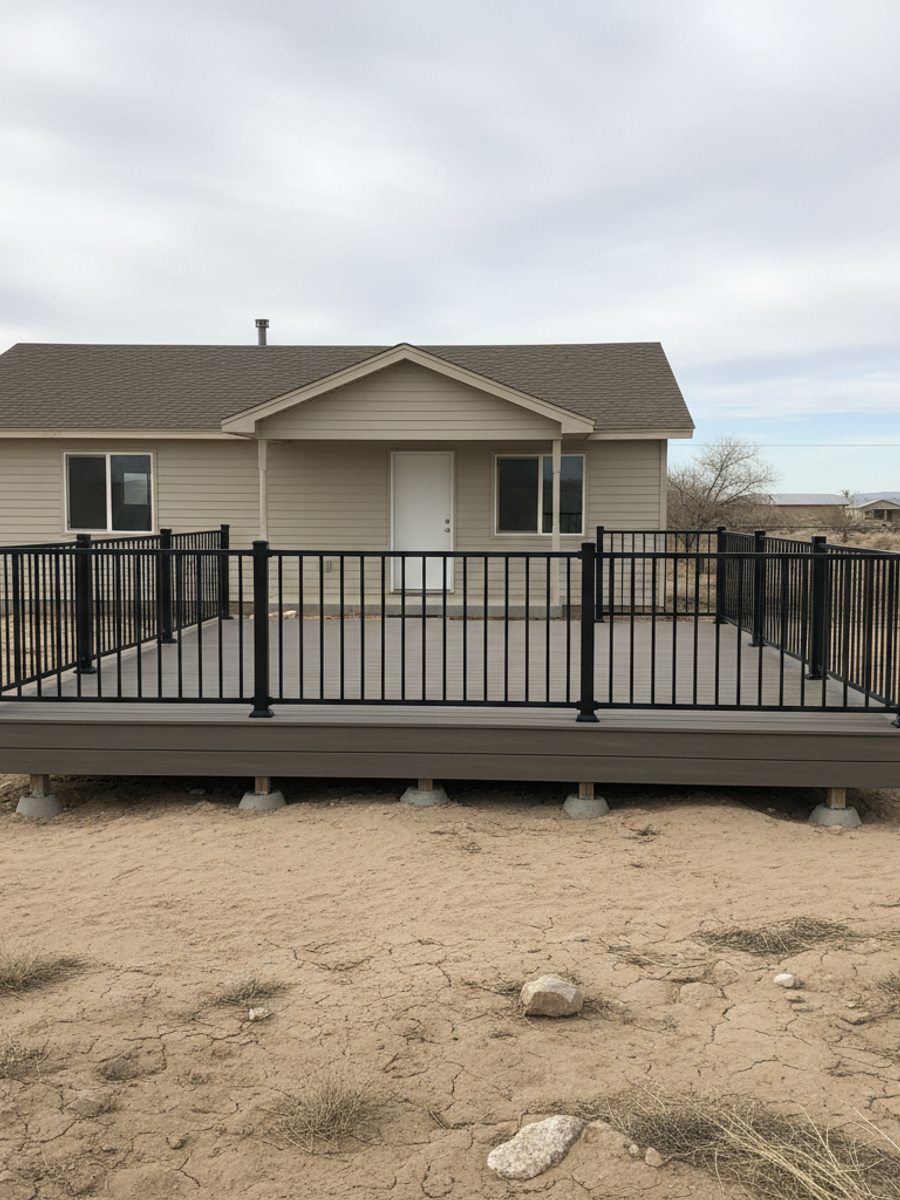
Picking a deck builder here isn't the same job as picking one in a state with topsoil and rain. Las Vegas ground and Las Vegas sun both push back on a deck in ways that don't show up in a glossy brochure. If a builder can't talk about those two things specifically, that tells you something before you ever get to price.
What's actually under your yard
Most lots in the valley have a layer of caliche a foot or two down, sometimes less. It's a cemented calcium deposit, basically soil that's turned into soft rock, and a hand auger won't touch it. A footing that's supposed to go 18 inches down for bearing can hit caliche at 10 inches and stop cold. A builder who's worked here knows to bring a power auger with a carbide bit or a jackhammer attachment, and knows when it's worth switching to a wider, shallower footing pad instead of fighting the layer. Someone quoting your job off a generic footing spec, without asking what your soil looks like, is guessing.
Some pockets around the valley, especially older areas with more clay content, will also swell and shrink a little with moisture changes. It's not the expansive clay problem you'd see in parts of Texas, but a ledger attached without a proper footing under the posts can still settle unevenly over a few years. That shows up as a deck that's pulled slightly away from the house or a board line that's gone out of level on one side.
What 115 degrees does to a deck
Summer surface temperatures on a south or west-facing deck can run well past the air temperature. Composite boards will get too hot to walk on barefoot by early afternoon in July, and dark-colored boards move more than light ones, both in temperature and in dimension. A good installer leaves proper gapping between composite boards, usually around 3/16 to 1/4 inch depending on the brand, specifically to handle that expansion. Skip it, and boards buckle at the ends by the second summer.
Wood decking dries out fast here. A cedar or pressure-treated board that's fine going down in February can cup or split by August if it wasn't sealed within the first few weeks, because our air is dry enough to pull moisture out of the wood faster than it would almost anywhere else in the country. That's a real reason staining and sealing isn't optional maintenance here, it's part of keeping the wood from checking apart. Fasteners matter too. Hidden fastener clips and screws should be stainless or coated for UV and heat resistance, not whatever was cheapest at the yard.
Permits, inspections, and HOAs
Depending on where you are, your permit runs through the City of Las Vegas, Henderson, North Las Vegas, or unincorporated Clark County. All of them want a permit for a new deck attached to the house, and most want one for anything elevated or requiring footings, even if it's detached. Expect at least two inspections: one for the footings before concrete goes in, and a framing inspection before the decking boards go down and cover everything up. A builder who tells you permits aren't necessary for your project, or offers to skip the inspection to save time, is putting the whole structure's legal status and your resale on the line to save themselves a phone call.
If you're in Summerlin, Henderson's master-planned communities, Anthem, or most newer subdivisions built since the 1990s, you're almost certainly in an HOA with design review. They'll want to approve height, railing style, sometimes even stain color, before work starts. Builders who work here regularly usually have the submittal package ready to go. In older neighborhoods, Charleston Heights, the Scotch 80s, parts of John S. Park, you're less likely to have an HOA but more likely to find a deck that was built decades ago without a permit at all, which matters if you're planning a repair or a tie-in to existing framing.
What to actually ask before you sign anything
- Ask for their contractor's license number and look it up yourself with the Nevada State Contractors Board. It takes five minutes.
- Ask what footing depth they plan for your specific lot, and whether they've hit caliche on jobs near you before. A vague answer here is the single biggest tell.
- Ask about the gap spacing on composite decking and why. If they don't have a number, they haven't installed enough of it.
- Ask who pulls the permit, and get it in writing that it's included in the price, not an add-on discovered later.
- Get the payment schedule in writing. A deposit is normal. Being asked for most or all of the money before the footings are even dug is not.
Red flags worth walking away from
A quote that's dramatically lower than everyone else's usually means thinner footings, wrong fastener grade, or no permit at all, and you inherit that problem later, not the builder. Anyone who won't put the material brand and board thickness in writing on the contract is leaving room to substitute something cheaper mid-job. And if a builder can't tell you roughly how many days before you should expect to walk on new framing or how long a stain needs to cure before rain or sprinklers hit it, they haven't done enough of these to know the timeline by feel yet.
None of this is complicated once you know what to ask. It just isn't obvious until something's already gone wrong, and a deck is expensive enough that it's worth getting the questions right the first time. If you want to see how we handle footings, materials, and the permit process on jobs around the valley, our deck builder work is laid out at Omega Deck Inc.