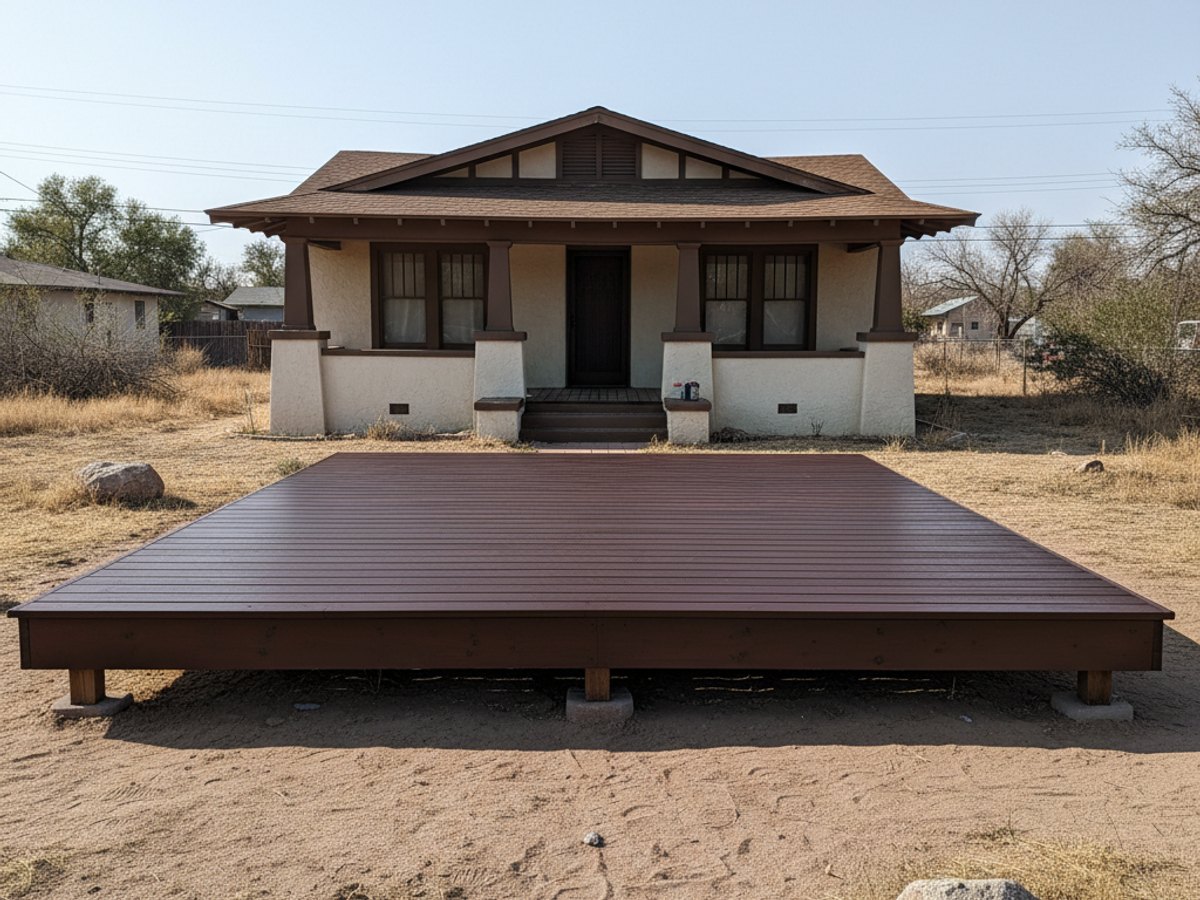
Most homeowners picture soil as dirt, something you dig through. In Las Vegas that's often wrong. Go down 12 to 24 inches on a lot anywhere from Summerlin to Henderson and you'll likely hit caliche, a hardpan layer of calcium carbonate that's cemented the sand and gravel together almost like weak concrete. It didn't form overnight. It's taken thousands of years of mineral-rich water evaporating and leaving deposits behind. For a deck builder, it changes the job the moment the first post hole gets dug.
This isn't a post about which deck to pick or when to schedule the work. It's about what's actually under your yard and why it dictates how the structure above it gets built.
Digging through caliche changes the footing plan
A standard post-hole auger stalls out on caliche. Sometimes it's a thin crust you can break through with a digging bar. Sometimes it's two feet thick and you need a breaker bit on a skid steer or a hand tamper and a lot of patience. Either way, it takes longer than digging in loam or sand, and it has to be priced and scheduled for that, not guessed at.
The upside is that caliche, once you're through it, is an excellent base to bear weight on. It doesn't compress or shift the way loose fill does. We still pour footings below it rather than resting posts on top of it, usually 24 to 36 inches deep depending on the deck's height and span, with concrete and a post base bracket that keeps the wood off the ground. Setting a post directly in a caliche-lined hole without proper concrete encasement is a shortcut that shows up as a wobble in two or three years.
Flash flooding on hard ground
Las Vegas gets roughly 4 inches of rain a year, which sounds like nothing. The problem is when it falls. Monsoon season runs July through September, and the storms are short, intense, and land on soil that's been baked dry and semi-sealed for months. Dry caliche and compacted desert soil don't absorb water fast. It runs instead of soaking in, which is exactly how Las Vegas ends up with flash flood warnings on streets that are bone dry the rest of the year.
For a deck, that means grading matters more here than the rainfall total would suggest. We slope the ground under and around a deck away from the house, and we don't backfill post holes with loose dirt that creates a channel for water to pool against a footing. On lots backing up to a wash or a drainage easement, which is common in newer Henderson and North Las Vegas subdivisions, we also check where the water goes during a downpour before footing placement, not after.
What the heat does to lumber, concrete, and composite
Summer daytime temperatures sit above 105 for weeks at a stretch, June through August. That affects the build in a few concrete ways. Poured footings cure faster in that heat, which sounds good, but a fast surface cure with a dry interior is weaker than a slow, even one, so we keep new concrete damp for the first few days rather than letting the sun pull the moisture out early.
Wood decking moves with humidity swings more than with heat alone, but composite decking moves with heat directly. Most composite boards expand and contract along their length as the temperature swings 50 or 60 degrees between a January morning and a July afternoon. Gapping boards correctly at install, usually an eighth to a quarter inch depending on the product, keeps that movement from buckling a board or popping a fastener two summers in. Skip that step and the deck looks fine at the walkthrough and tells on itself the following August.
Permits, setbacks, and HOA review
A deck attached to the house in Clark County, or inside the city limits of Las Vegas, Henderson, or North Las Vegas, generally needs a building permit, and the footing depth and ledger attachment to the house both get inspected before the decking goes down. Free-standing structures and the framing itself get checked too, depending on size and height off grade. If your property backs up to a drainage easement or sits near a setback line, that gets confirmed against the plot plan before anything is dug, not assumed.
HOAs are the norm rather than the exception across most of the valley, from Summerlin to Anthem to Mountain's Edge. Architectural review can take a couple of weeks on top of the city or county permit timeline, and it usually wants to see the railing style and decking color before approving anything. Folding that into the schedule early saves a homeowner from having lumber on site and no sign-off to build with it.
Older lots versus newer subdivisions
A house in Charleston Heights or the John S. Park area was likely built in the 1950s through the 70s, and what's buried in that yard is less predictable. Old irrigation lines, abandoned sprinkler heads, sometimes a chunk of old concrete patio that was never fully removed. We run a locate and probe the dig area before setting footings on those lots, because hitting something unexpected mid-dig costs more time than checking first.
Newer subdivisions built from the 1990s on tend to have more consistent fill and grading, since the lots were engineered as a tract rather than built up individually over decades. The caliche is often still there, sometimes closer to the surface because of how the pad was cut and compacted during construction. Consistent ground is easier to plan for, but it isn't necessarily softer digging.
None of this is complicated once you know it's there. It's just the difference between a deck that's built for this specific ground and one that's built like it's going in a backyard in Ohio. We've dug through enough caliche in enough Las Vegas yards to know where the shortcuts are and why we don't take them. If you're planning a build, repair, or a resurfacing job anywhere in the valley, Omega Deck Inc can walk the lot with you before a single hole gets dug.